Luxury Corporate Gifts: Getting Year-End Client Gifting Right
A client gift that respects their policy, arrives before the office closes, and still feels chosen for one person
Read MoreeastSixty years of Le Mans machinery racing the same 13.65 kilometres the modern cars use, including the public roads
Le Mans Classic is a historic motorsport meeting held on the grounds of the 24 Hours of Le Mans, created by Peter Auto and Richard Mille in association with the Automobile Club de l’Ouest. It began in 2002 and has run every other year in July, on the full 13.65-kilometre Circuit de la Sarthe — the same layout the modern race uses, including the sections of public road.
The field is divided into grids by era, covering the decades of Le Mans history from the 1920s onwards. Each grid races three times across the weekend, and, crucially the schedule is arranged so that every grid runs at least once in darkness. Seeing cars from the 1950s on the Mulsanne straight at two in the morning is the reason the event exists.
Most historic racing happens on shortened club layouts or permanent circuits that have been altered beyond recognition. Le Mans Classic uses the real thing: the Dunlop bridge, the Esses, Tertre Rouge, then the Mulsanne straight with its two chicanes, Mulsanne corner, Indianapolis, Arnage, and the run back through the Porsche curves.
Between events, most of that is the D338 and the D140 — ordinary French roads with hedgerows and farm entrances. Driving a 1960s prototype down them at speed is not something that can be replicated anywhere else, and it is why owners bring cars to Le Mans that they will not race at other historic meetings.
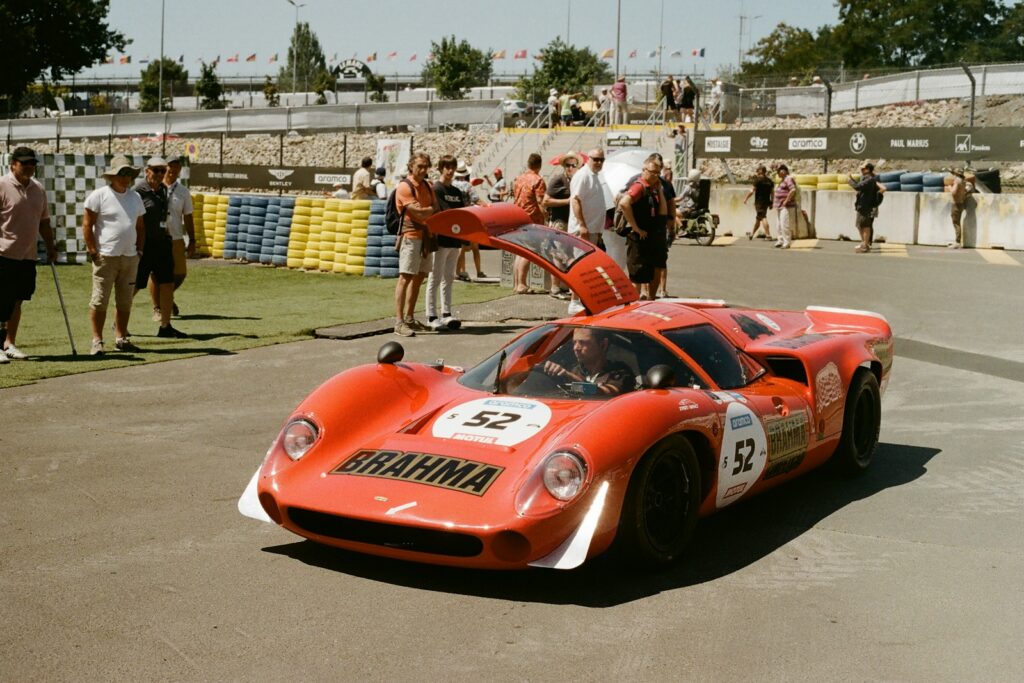
Practice and qualifying occupy the Friday. Racing runs from Saturday afternoon straight through to Sunday afternoon, following the pattern of the twenty-four hours without being one — grids rotate, so there is always something on track, and the paddock is open throughout.
Alongside the racing sit the club displays: several thousand cars brought by owners’ clubs from across Europe and parked inside the circuit by marque. For many visitors the club paddocks are the better half of the event, because the cars are unroped and the owners are standing next to them.
Tell us which July you are in France and we will build the twenty-four hours around you
Eligibility runs by period and by specification, and the grids are curated rather than open — a car needs to be the right type for the era and prepared to a standard the organisers accept. For an owner with something suitable, this is one of the few events where the car, rather than the owner, earns the invitation.
The practical burden is considerable: transport to the Sarthe, a period-correct preparation, a licence, and a crew for a weekend that runs through the night. Most owners who do it once do it every time, which tells you something about the experience of driving the Mulsanne straight in the dark in a car that raced there sixty years ago.
The club displays are also where a purchase often starts — several thousand cars parked by marque, with owners who know exactly what theirs is worth and who is selling.
The Sarthe itself is Loire country at its northern edge — chéteaux, vineyards, and quiet roads — which turns a racing weekend into a week with very little effort.
For anyone who follows this end of motorsport, the Classic pairs naturally with the 24 Hours in June and the Spa 24 Hours in Belgium — three endurance weekends on two of the great circuits.
In July, every other year, at the Circuit de la Sarthe near Le Mans
No. It has run biennially since it began in 2002
Yes — the whole 13.65 kilometres, including the sections that are public road for the rest of the year
Yes, and it is deliberate. The schedule ensures every grid runs at least once in darkness
Period Le Mans machinery grouped into grids by era, from the 1920s onwards, racing three times each across the weekend
Six to nine months for hospitality and accommodation in the Sarthe; longer for an entry
Not yet, but as a biennial event held in odd years, Le Mans Classic 2027 is expected to follow the usual July slot.
Sales typically open around a year ahead through the organiser’s site, with grandstand and paddock packages selling first.
Exact dates are usually announced the preceding autumn, though the event consistently falls on a July weekend.
Friday practice is followed by two full days of grid racing, with the traditional night session run somewhere across the programme.
Yes, classic Le Mans tickets are booked independently of the 24 Hours of Le Mans, through the event’s own ticketing channel.