Luxury Corporate Gifts: Getting Year-End Client Gifting Right
A client gift that respects their policy, arrives before the office closes, and still feels chosen for one person
Read MoreeastThe most dangerous race ever run on public roads, and the four-day rally that carries its name now
The Mille Miglia — the Thousand Miles — was an open-road endurance race established in 1927 by a group of Brescian enthusiasts led by Count Aymo Maggi, run from Brescia to Rome and back. The first edition was held on 26 and 27 March 1927. Clemente Biondetti won it more times than anyone and Alfa Romeo won it more often than any other manufacturer.
It was run for the last time on 11 and 12 May 1957. From 1953 it had been a round of the World Sports Car Championship, and by then it was being contested at speeds no public road could absorb — with five million Italians standing at the roadside. The 1957 edition ended in a crash that killed a driver, his navigator and nine spectators, and the Italian government stopped it.
In 1977 the name was revived as a regularity event rather than a race. Entry is restricted to cars built no later than 1957 of a model that ran in the original event or was entered for it, and every application goes through a selection committee — which is a genuinely narrow gate, and the reason the field is what it is. Roughly four hundred cars take part, and the grid is worth more than most museum collections.
A regularity event is not a race against the clock but against instructions: crews are required to cover sections at prescribed average speeds and are penalised for being early as much as late. The winner is usually a crew nobody outside the sport has heard of, driving a small pre-war car with great precision. The Ferraris and Mercedes that draw the crowds rarely win it.
The modern event runs over four or five days each June, from Brescia down one side of the peninsula to Rome and back up the other, through the Marche, Umbria, and Tuscany. The route changes year to year but the shape holds, and the towns on it treat the passage of the cars as a civic event — closed squares, crowds at midnight, and no barriers to speak of.
That is the reason to go. Spectating at a circuit means a grandstand; spectating at the Mille Miglia means standing in a piazza in Siena or on the road below Radicofani while four hundred period cars come through. Choosing the place is most of the planning.
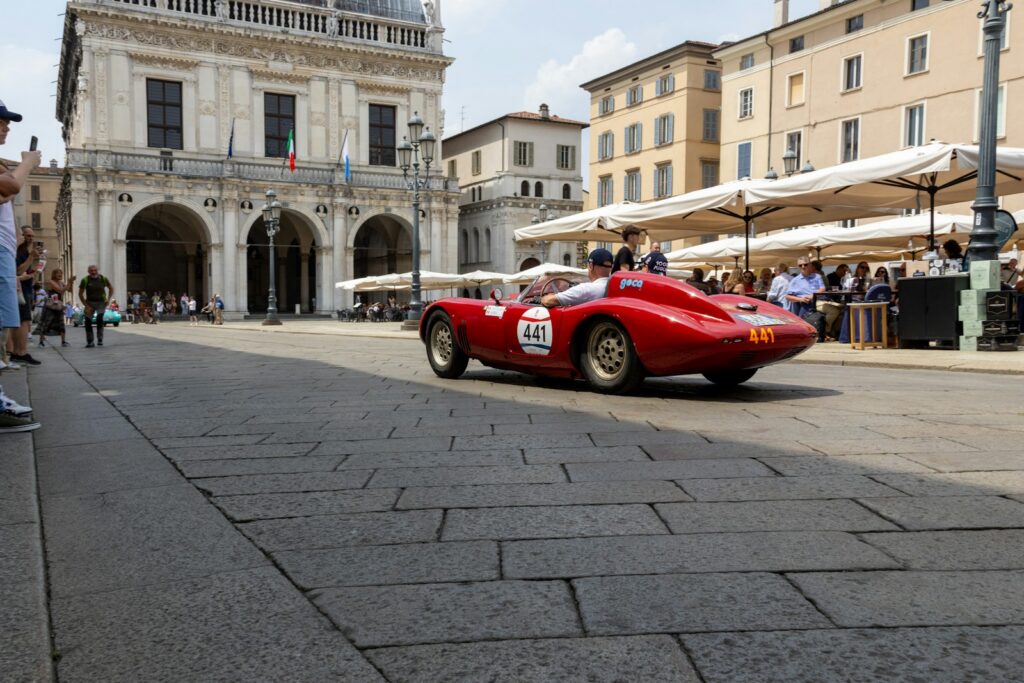
A note on what the modern event has become commercially. The Mille Miglia is now supported by manufacturers and watchmakers who use it as a stage, and the field includes works entries running alongside private owners. That has kept it wealthy and well organised, and it has also made entry considerably harder to obtain for a car without a story attached to it.
The event also passes through some of the best driving country in Europe, which for anyone bringing a modern car of their own is reason enough to be on the route a day ahead of the field.
Tell us whether you are driving or watching and we will build the week on the route
If a car of the right period is already in the family, the Mille Miglia is one of the few events in the world where the car is most of the qualification. If not, the event is still worth the week — it is the only place left where cars of that age are driven hard on open roads rather than displayed on grass.
No. The original race ran from 1927 to 1957 and was stopped after a fatal crash. Since 1977 the name has belonged to a regularity event for period cars
Cars built no later than 1957 of a model that ran in, or was entered for, the original event. Applications are reviewed by a selection committee
Crews must cover sections at prescribed average speeds. Arriving early is penalised as heavily as arriving late, so precision beats speed
Brescia to Rome and back over four or five days each June, through Tuscany and the Marche. The exact route changes annually
In the towns rather than on the open road — the squares in Tuscany, and the start and finish at Brescia
A year or more for an entry, and several months for accommodation once the route is published
The 2027 edition is expected in mid-June, continuing the event’s traditional early-summer slot.
The Mille Miglia route covers roughly 1,800 km from Brescia to Rome and back, split into several timed stages each day.
Mille Miglia 2027 dates are released by the organisers each winter, usually a four-day window in mid-June.
Mille Miglia Storica is the official name for today’s re-enactment, open only to models that ran the original 1927-1957 race.