Luxury Corporate Gifts: Getting Year-End Client Gifting Right
A client gift that respects their policy, arrives before the office closes, and still feels chosen for one person
Read MoreeastThe oldest of the five Classics, run on a course that no trainer would design today
The Derby Stakes is a Group 1 flat race for three-year-old colts and fillies, run at Epsom Downs in Surrey on the first Saturday of June. The distance is a mile, four furlongs and ten yards — a little over 2,400 metres. It was first run in 1780, which makes it the oldest of the five English Classics and among the oldest continuously contested sporting events anywhere.
It is also Britain’s joint richest flat race, and the one that defines a stallion’s commercial value for the rest of his life. A Derby winner is worth a different order of money than a horse that finishes second, which is why the race carries a weight of consequence that no other Saturday afternoon in racing does.
Epsom is not a modern racecourse and nobody would build it now. The first half climbs, the top of the hill falls away to the left, and the field then comes down Tattenham Corner — a descending left-hand bend taken at racing speed — before a straight that cambers towards the inside rail.
The consequence is that the Derby asks questions no other mile-and-a-half race asks. A horse needs to stay, to handle a gradient in both directions, and to balance itself round a corner that unsettles animals bred for flat, galloping tracks. Every year horses that are demonstrably the best in the field fail to handle Epsom, and every year that is treated as a surprise.
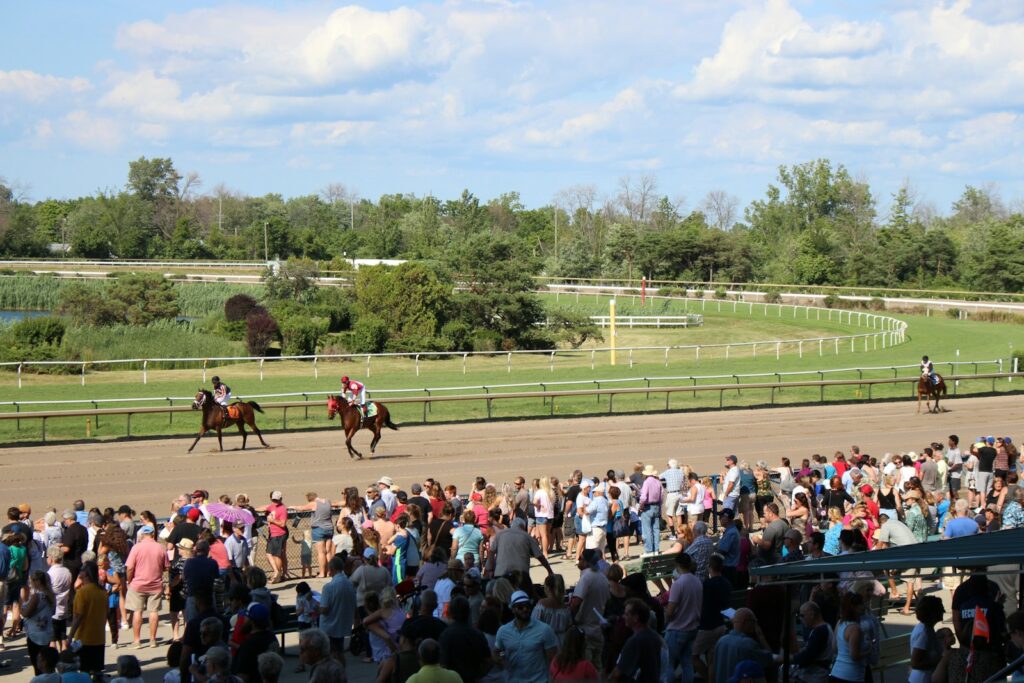
Derby Day is not Royal Ascot. The Queen’s Stand keeps a formal dress code, but there is no royal procession, and the Downs themselves — the open ground inside the course — have been free to the public for two centuries. That is the character of the day: a hundred thousand people, a fairground on the hill, and one of the great races of the world going on in the middle of it.
For anyone entertaining, this split is the useful thing to understand. The grandstand and the private boxes are a formal racing day; the Hill is an institution of a different kind. Both are the Derby, and the choice between them is the choice that shapes the afternoon.
Tell us which June you are in England and we will build the Derby Saturday around you
English flat racing has five Classics, all for three-year-olds: the Two Thousand Guineas and the One Thousand Guineas at Newmarket in the spring, the Derby and the Oaks at Epsom in June, and the St Leger at Doncaster in September. The Derby is the middle distance and the middle of the season, and it is the one that settles reputations.
The Triple Crown — Guineas, Derby and St Leger — has not been won since 1970, because modern breeding does not produce a horse that can win over a mile in May and a mile and three quarters in September. That gap is part of why the Derby now stands alone rather than as one leg of something larger.
The Oaks, the fillies’ equivalent over the same course and distance, is run on the Friday, which for anyone making a weekend of it turns Epsom into two days rather than one.
Worth saying plainly: general admission to Derby Day is inexpensive and open to anyone, and the Hill costs nothing at all. What we arrange is not entry but the version of the day that involves a box, a paddock pass, and a car that gets you out afterwards.
On the first Saturday of June each year, at Epsom Downs Racecourse in Surrey
A mile, four furlongs and ten yards — a little over 2,400 metres
1780, which makes it the oldest of the five English Classics
Three-year-old colts and fillies only. A horse has one chance at the Derby and no more
The descending left-hand bend into the straight, and the part of the course that unsettles horses bred for flat tracks
Yes, in the Queen’s Stand, where morning dress or a dark suit and tie is expected. Elsewhere the Derby is a public occasion rather than a formal one
5 June 2027, held as usual on the first Saturday of the month at Epsom Downs Racecourse.
Yes, the fixture runs Friday and Saturday, with the Oaks for fillies contested the day before Derby Day itself.
Epsom Derby tickets span free admission to the Hill up to premium grandstand packages, released each spring via the Jockey Club’s official site.
Epsom Derby dates are fixed to the first Friday and Saturday of June, with Derby Day itself always falling on the Saturday.
The race is run mid-afternoon on Derby Day, with the official start time confirmed closer to the meeting.